
CCTV · 4 min read
IP vs analog CCTV: which is right for your business?.
For most offices, factories, hospitals and schools, IP CCTV is the better choice: sharper footage, one cable for power and video, smart alerts and easy expansion. HD analog still makes sense for small sites with up to 8 cameras, a tight budget or existing coaxial cabling.
Choosing between IP and analog CCTV is the first decision in any surveillance project, and it shapes everything that follows: the cameras, the recorder, the cabling, the storage and how easily the system grows. This guide explains the real differences in plain language, so you can pick the right system for your site.
How each system works
HD analog CCTV (DVR-based)
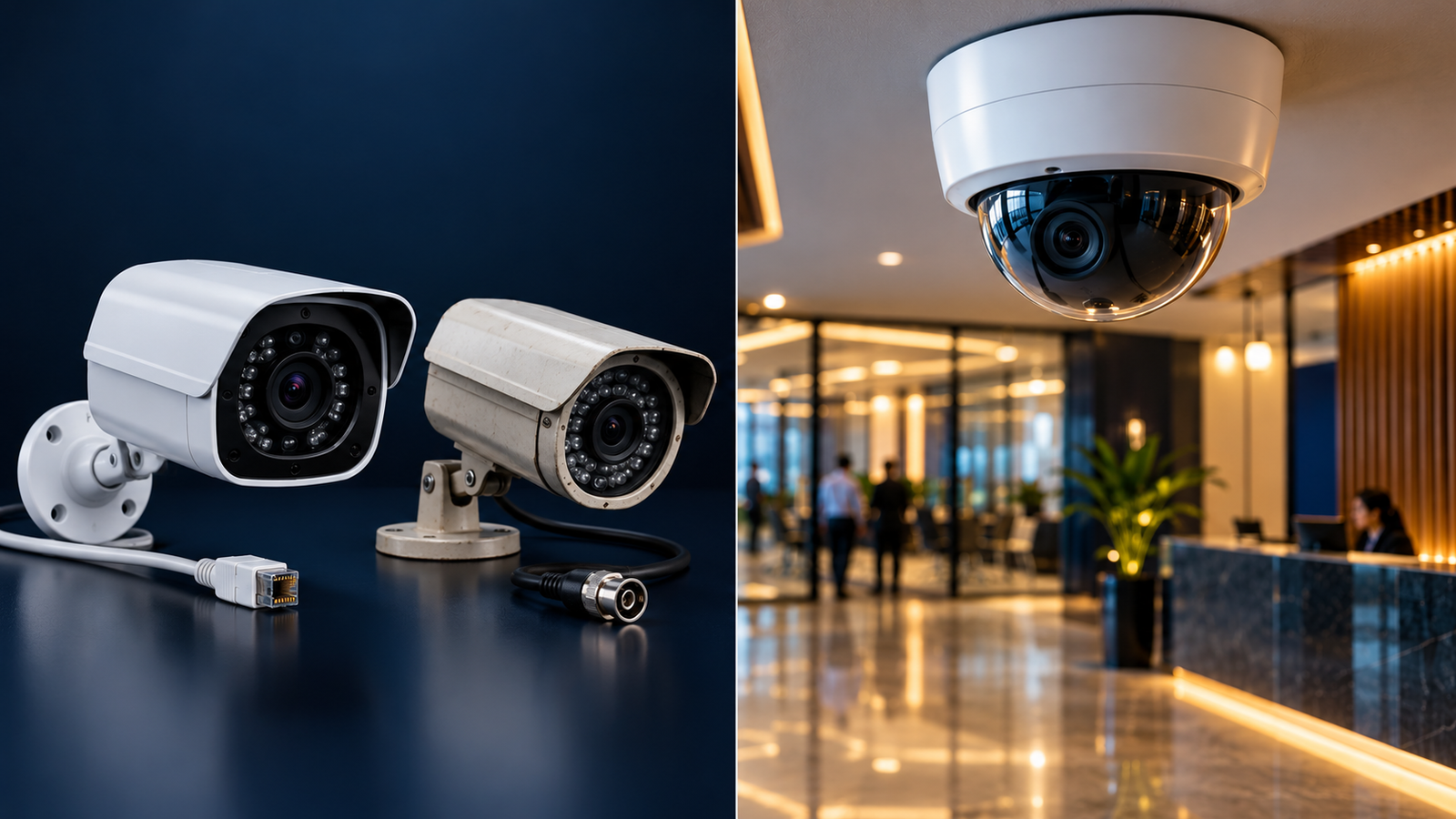
Analog cameras send video over coaxial cable to a DVR (digital video recorder), which converts and stores it. Modern HD analog formats such as AHD, HD-TVI and HD-CVI deliver 2MP to 5MP video, which is far better than old analog systems. Each camera usually needs a separate power supply.
IP CCTV (NVR-based)
IP cameras are small computers. They process video inside the camera and send it over a network cable to an NVR (network video recorder). With PoE (Power over Ethernet), one Cat6 cable carries both power and data, which keeps installation clean.
IP vs analog at a glance
| Factor | HD analog (DVR) | IP (NVR) |
|---|---|---|
| Image quality | 2MP to 5MP | 2MP to 8MP and above |
| Cabling | Coaxial + separate power | One Cat6 cable with PoE |
| Cost per camera | Lower | Higher |
| Smart features | Basic motion detection | Line crossing, intrusion, people counting |
| Remote viewing | Possible, more limited | Smooth, multi-site dashboards |
| Expansion | Limited by DVR channels | Add cameras through network switches |
| Best for | Small shops, budget sites | Offices, factories, hospitals, campuses |
Image quality: can you identify a face?
Resolution decides whether footage is useful as evidence. At an entrance or a cash counter, you need to identify people, not just see that someone was there. IP cameras deliver higher resolution, better low-light performance and wide dynamic range (WDR) for bright doorways, which makes faces and number plates easier to read.
HD analog at 2MP is fine for general overview areas such as corridors and storerooms, but it struggles with detail at a distance.
Cabling and installation
- Analog can reuse existing coaxial cable, which saves labour when you upgrade an older site.
- IP uses one network cable per camera with PoE, so there is no separate power wiring at every camera point.
- Long runs: analog coax can travel further without extra equipment, while IP runs over 100 metres need a switch or fibre link in between.
Cost comparison
Analog cameras and DVRs cost less upfront. IP systems cost more at the start, but the gap narrows once you count cabling, power supplies and the cost of upgrading later. For a full price breakdown, read our CCTV installation cost guide.
| System size | HD analog (indicative) | IP (indicative) |
|---|---|---|
| 4 cameras | ₹20,000 to ₹35,000 | ₹30,000 to ₹50,000 |
| 8 cameras | ₹35,000 to ₹60,000 | ₹50,000 to ₹1,00,000 |
Storage and recording
IP cameras with H.265 compression store high-resolution video efficiently. Many also support edge recording to a memory card, so footage is kept even if the network link to the NVR drops. Analog systems record everything at the DVR, so a DVR failure means lost footage.
Smart features and remote viewing
- Line-crossing and intrusion alerts sent to your phone.
- People counting and heat maps for retail.
- Number-plate recognition at gates.
- One dashboard to view several branches.
These features are standard on most business IP cameras and limited or missing on analog systems.
Compliance: internet-connected CCTV cameras sold in India now need STQC certification under the government’s Essential Requirements, with full enforcement from April 2026. Ask your vendor for the certificate, whichever system you choose.
Which one should you choose?
Choose HD analog if
- You need 8 cameras or fewer.
- You already have good coaxial cabling.
- You only need basic recording and viewing.
- Budget is the main constraint.
Choose IP if
- You need to identify faces or number plates.
- You plan to add cameras or branches later.
- You want smart alerts and smooth mobile viewing.
- You are building a new site or rewiring anyway.
Many businesses also run a hybrid setup: existing analog cameras stay on a hybrid recorder while new IP cameras are added at key points. It is a sensible way to upgrade in stages.
How DVM Tech helps
Our engineers survey your site, mark where you need overview and where you need identification, and recommend IP, analog or hybrid based on what actually fits. See our CCTV and surveillance services or book a free site survey.
Frequently asked questions
Is IP CCTV better than analog?
Can I mix IP and analog cameras?
Does IP CCTV need internet?
How far can an IP camera cable run?
Which is cheaper to maintain?
Start a project
DVM Tech India Pvt. Ltd.Tell us about your site. One accountable team will design, install and support it, from the first survey to long-term AMC.